AR in B2B: Revolutionizing Commerce
, Demodern

Augmented Reality (AR) is rapidly gaining traction in E- and M-Commerce. Now available on many smartphones, it is also gaining approval from online retailers and customers in B2B commerce. Alex explains to marconomy.de why AR technology is becoming successful in B2B shopping and what needs to be considered.
AR versus 'buying a pig in a poke'
Many customers in the B2B sector are no longer satisfied with placing orders through traditional online shops. They also want to be clear about the actual dimensions or scale of a product. "Try before you buy" thus applies not only to products in the fashion sector but also to the car configurator or the new air compressor. Augmented Reality provides a remedy here: Thanks to this technology, the manager of a craft business no longer has to rely solely on his imagination when he wants to purchase a suitable shelving system for his storage rooms. In the near future, it will be natural for customers to view products from all areas in the desired version and place them virtually before purchasing. For example, Amazon's smartphone app already includes augmented reality technology, allowing the placement of various products such as kitchen and electronic appliances or furniture.

At the same time, AR enriches online commerce with many factors that only brick-and-mortar retail could boast so far – namely, being able to experience products spatially visualized. With consequences – also for the logistics industry: Because customers will know exactly what they are ordering before purchasing, there will be fewer returns in the future.
Rethinking product development and production
The AR technology offers significant advantages not only in the interaction between customers and companies but also directly in the development of new products. AR applications can generally be a real game changer in product prototyping, as they enable early visualization of components and mechanical relationships. Functional elements can be viewed and tested directly on the model. But not only that: Companies can even design and test entire products such as furniture or home accessories in AR/VR environments. Combined with advanced 3D printing, these could then be produced and tested directly on-site in the future.
AR "expands" the physical sales space
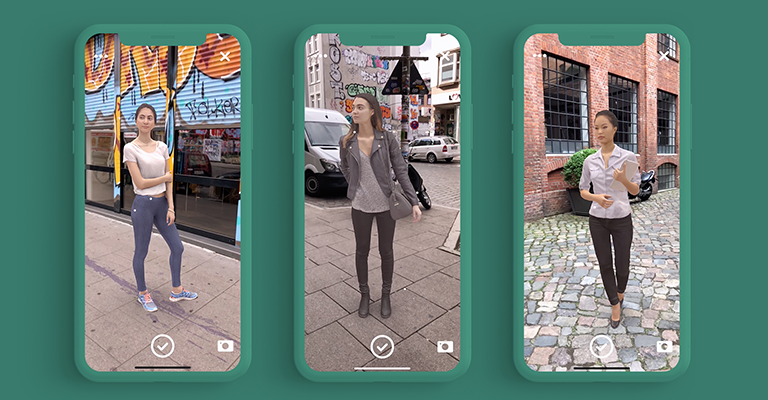
AR will make a difference not only in online shopping in the future. The technology also brings significant advantages for brick-and-mortar retail, bridging the gap between the physical sales counter and e-commerce. On one hand, customers in the B2C and B2B sectors will experience a completely new shopping experience thanks to AR: Products can be personalized and configured directly on-site, and passersby can experience products directly in shop windows using AR. On the other hand, brick-and-mortar retail benefits, as limited sales space is no longer a disadvantage compared to online retail: For example, a specialty store for office equipment no longer needs to display or stock all conference tables in all versions. The customer could simply view the desired one virtually on-site in the store and order it immediately if interested.
AR in service: Your friend and helper
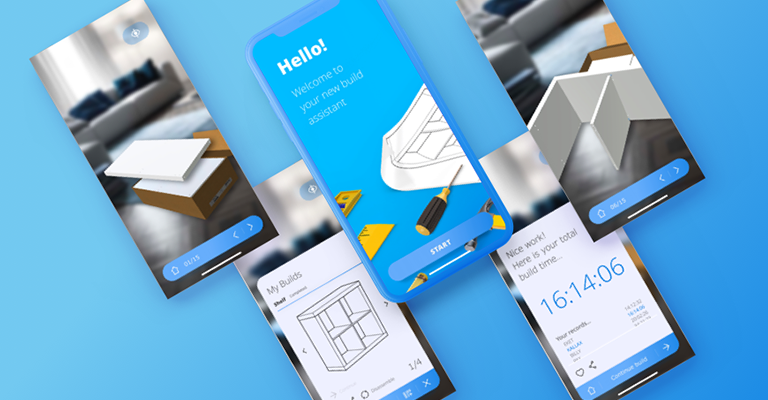
Many products require explanation – especially in the B2B sector. How does the new manufacturing robot work? User manuals and service portals are often difficult to understand and cumbersome to use, service technicians are expensive and not available 24/7. But with the help of augmented reality, a lot will change in terms of service as well. Because AR can display how-to information and interactive assembly instructions directly on the product and enrich them with additional information that makes assembly or maintenance easier for the user. An example from the B2C sector is the "IKEA AR Build Assist", a furniture assembly guide that spatially visualizes and explains step by step how to assemble the piece of furniture. Such and similar services benefit not only the manufacturers of a product but also the retailers, who can stand out from other retailers with such an offering.
AR: 3D data is a must
The arguments for using AR are compelling in both brick-and-mortar and online retail. However, if a retailer wants to use an AR application for their purposes, it is not enough to develop and establish one: Companies for which augmented reality can be a revenue driver must align their entire infrastructure and digital ecosystem for the use of augmented reality – this also applies to retail. In short: Anyone offering AR in their shop needs 3D data of the offered products. Not only is the development of 3D product data in different quality levels for various end devices and usage scenarios indispensable, but also the corresponding data infrastructure to serve all platforms.
Conclusion
AR can become a game changer in B2B commerce because the technology enables successful omnichannel integration that benefits both e-commerce and brick-and-mortar retail. Both worlds no longer compete for the user's favor but perfect the shopping experience when applied correctly. AR thus offers the opportunity to achieve higher sales in the future while gaining important insights for future purchasing decisions.
You can find the article on marconomy.de here.