Empathy Machine Virtual Reality - How We Made a Rabbit Talk Using Realtime VR
, Demodern

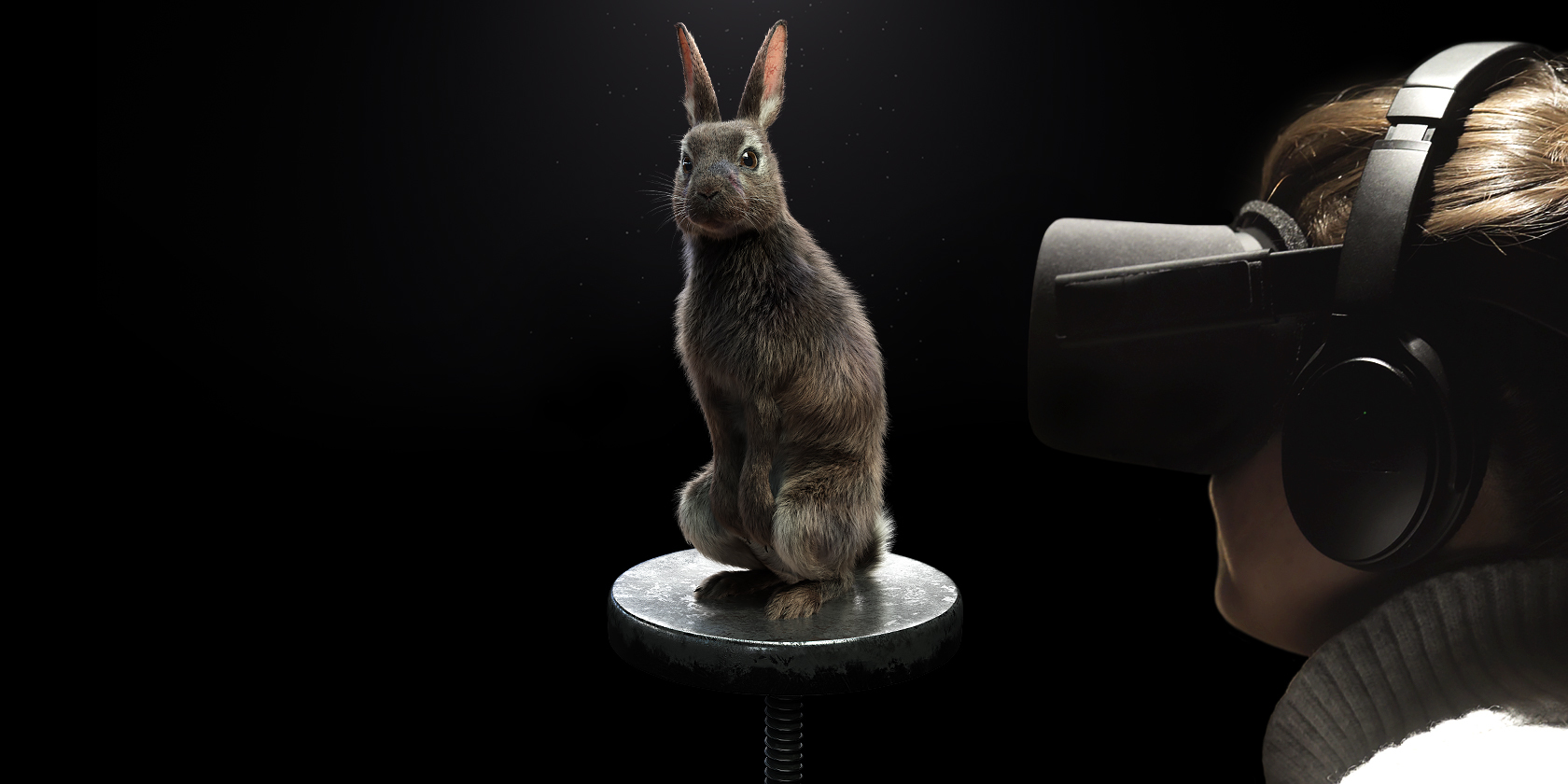
Emotional influence is THE keyword in immersive Virtual Reality. The user is fully immersed and more emotional. This can be utilized – and for a good cause. The Virtual Reality Experience “Eye to Eye” that we developed with the animal protection organization PETA and Kolle Rebbe plays with a new form of communication and questions the interaction between humans and animals in a virtual environment in an emotional way. The user can speak with a digital rabbit and is thus informed about the conditions of global animal husbandry. Facial expressions and speech are transferred to the virtual animal by an actor using a motion-capture system. So, one no longer just reacts to objects but communicates concrete messages to raise awareness of the suffering of animals and to promote a different or better way of interacting with them. Our experiment has already led hundreds of people to reconsider their behavior towards animals. It also had an effect on some of our employees, who then decided to adopt a vegetarian lifestyle.
The Perfect Simulation
Virtual Reality applications are “empathy machines”: The user puts on a headset and visits places they would otherwise never reach. They have experiences with the help of technology that they would otherwise never have and perceive the virtual situations almost as real. Emotions such as joy, sadness, and fear are experienced more intensely. The viewer becomes either a witness or a protagonist. Such a change in perspective can bring about positive changes in communication or mindset in people. They are more willing to embrace ideas that initially contradict their own life concepts. VR applications thus belong to the media categories with the strongest potential for empathetic influence.
Especially in virtual reality, we can offer users a perfect simulation. When users perceive only artificially generated images and sounds, subtle means are sufficient to draw attention to them. This creates a magic that captivates. The enclosed space in the virtual world allows for natural interaction. Because the user's attention is not distracted by anything. To avoid disturbing the immersion, we refrain from using controllers and other aids in the VR application we developed for IKEA, for example. Everything can be controlled through the direction of gaze and simple gestures like nodding. If, for example, the time of day, room, or lighting mood changes, it is immediately clear that there are new contents and interaction possibilities. Through this less complex navigation, our applications appeal to large user groups and not just the target group of “Digital Natives.”
Virtual Reality – Even More Realistic in the Future?
Virtual Reality can thus transport people into situations they would not normally experience. Our applications already show today that virtual worlds, as an immersive medium, are capable of influencing people emotionally. However, much more will happen in the future. We can look forward to it.
------------------------------------
The article was first published on September 12, 2018 - written by our Corporate Communication Manager Claudia - on the blog of OSK.