Facebook Groups as a Standalone App
, Demodern

About three weeks ago, Facebook released a new smartphone app: Facebook Groups. Alongside Facebook Messenger, which has now completely separated mobile messaging from the standard Facebook app, this new service aims to draw more attention to an important feature of the social media giant.
I am by no means a Facebook power user – currently, I use the platform more as a news feed, showing me current events around the websites I have subscribed to. Thus, within my news feed, fewer and fewer private things from friends appear, and more and more posts with informative or commercial goals – my Facebook wall has become an RSS feed. Magazines and brands have displaced friends and acquaintances.
And it wouldn't have to be this way if Facebook groups were simply integrated more prominently into the website and app. Currently, however, these are not only a neglected feature in the desktop version but especially on the smartphone. While they are at least relatively central within the left-hand navigation column on the desktop, the uninformed user has to search for them within the smartphone app. Both variants exhibit significant inconsistencies from a user experience perspective, making Facebook groups an inconspicuous, underestimated feature. My superficial criticisms range from inconsistent navigation within the app to an overwhelming and impersonal interface, thanks to the high text density combined with a simple list view.
I wished that Mark Zuckerberg would steer his company back towards the people who use Facebook. Instead, about eight weeks ago, I was informed on my smartphone that Facebook messages would now only be available in Messenger. In a recent statement given during a Q&A, the Facebook head stated that all good, successful apps could focus on exactly one core function. For Facebook, this is the news feed, so they want to counteract complexity in the future by releasing some important functions as standalone apps. An initially understandable step, which for me, however, does not exclude better integration of some of these functions into this very news feed. But if a function is outsourced to a standalone app, it should at least be ensured that the existing scope of these functions does not change, to avoid exposing the nearly 1.35 billion monthly active users to additional pain points. Unfortunately, they do – especially in the new Facebook Groups app.
The advantages of the new app are not entirely clear to me on the associated website. Not only because of a text maintenance error in the German version – the video also does not include clear advantage communication. General group features are mentioned here, such as "Share content that matters to you [...]" or "Create a group on any topic [...]". And even upon closer inspection of the app, it becomes clear that the groups relocated here can do no more, but rather less than their counterparts in the standard app. For example, content cannot be shared from within a group. Apparently, own posts can only be edited since a recent update. And the comment function does not allow embedding images. Three things that, in my estimation, will contribute to users being much less active here than in the normal app.
However, the app is much more modern and clearly designed. The user experience is state of the art at first glance: A clear navigation structure, info banners for first-time visitors explaining, for example, on what basis the Explore mode generates group suggestions, and clear settings options. Additionally, a very cheerful and playful, yet charmingly restrained user interface. Compared to the current groups, this is overall a big step forward.
Nevertheless, I think Facebook is putting obstacles in its own way with this app that need not exist. I would have wished for a completely different direction; one that makes the platform more like what it once was: My online connection to my friends and acquaintances. Groups represent my personal interests, where I want to exchange with like-minded people, share content privately, and engage in micro-sharing with those who are precisely interested in this content (otherwise, they probably wouldn't be part of this group). To be more specific: For such an important, opportunity-rich feature, I would have designed the following things to make it what it actually is:
1. Prominent Groups within My News Feed
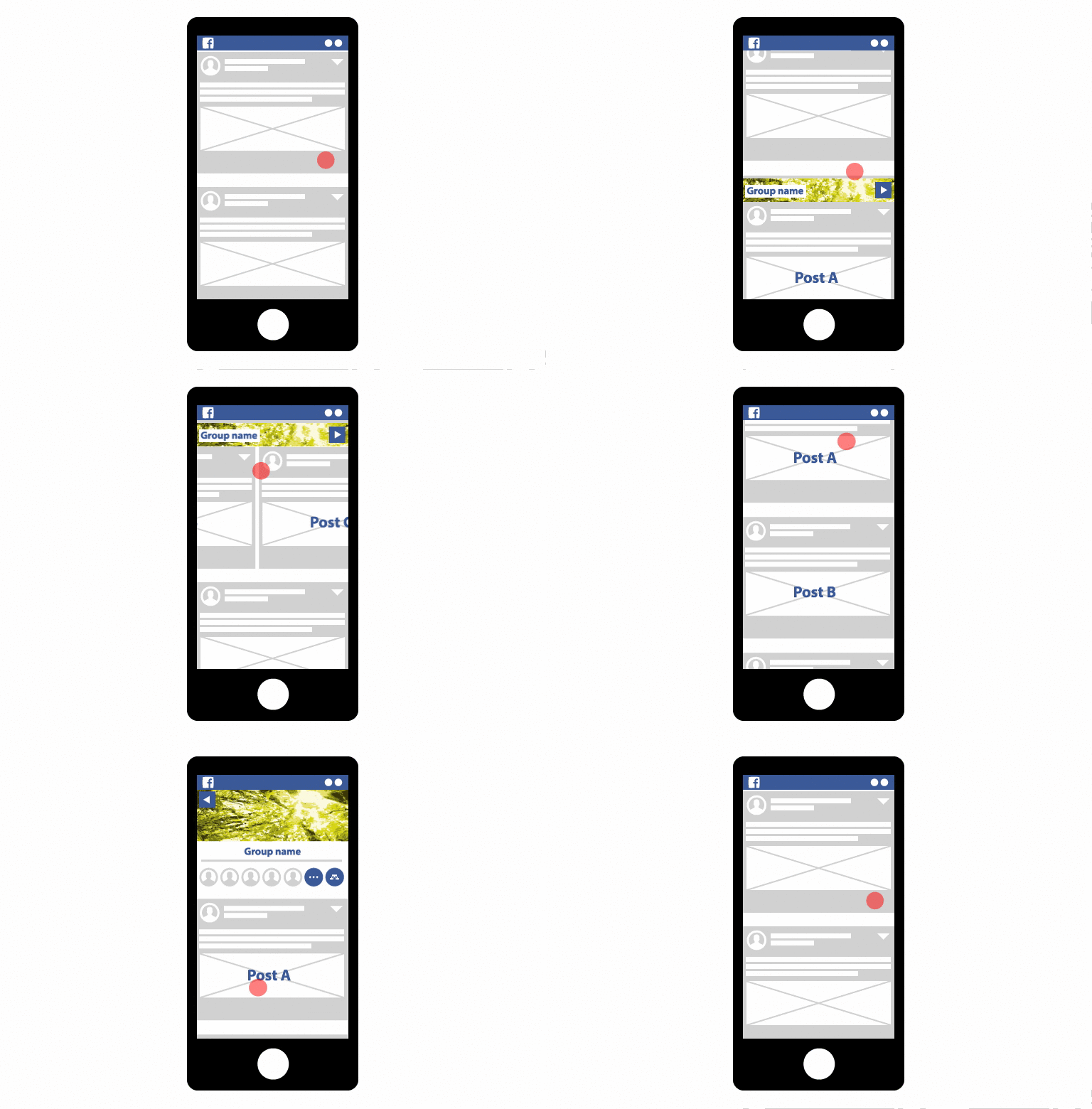
As mentioned, my first approach would have been a more integrative news feed. I would have prominently placed Facebook groups within the feed so that every user reading their personal feed would also find all new content from their groups there. The posts could be provided with a snippet of the group cover photo to clarify the affiliation at first glance. The user wouldn't have to leave the feed to view older group posts. Nevertheless, they could switch directly to an isolated view from here if needed.
2. Groups within Groups
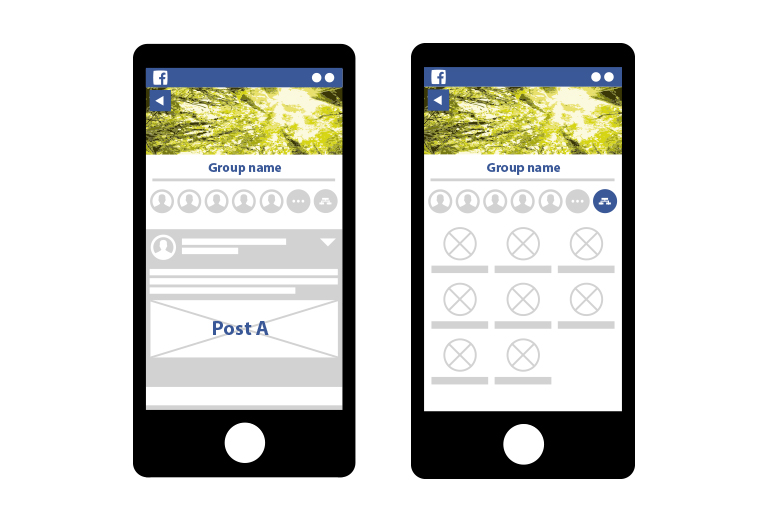
This initially sounds like Inception. But why shouldn't it be possible to create a subgroup within a group? Here in our agency, there was once a Facebook group where we exchanged interesting links and opinions of all kinds. The moment this exchange became more complex, however, we switched to Slack – a service that pretty much met our requirements for a communication group. Whether an announced app "Facebook at Work" goes in this direction will soon be revealed.
3. Expanded Group Management
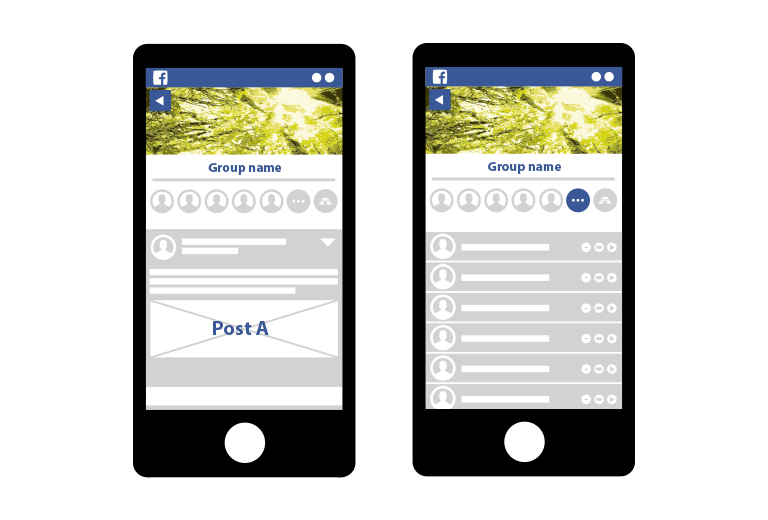
Save posts, search groups by content, manage stored files. And within the member overview: Switch to profile, message people, delete members. Obvious functions that shouldn't be too complicated to integrate.
Yes, Facebook is a gigantic platform used by an unimaginably large number of people. And with the number of users, the number of devices used also increases. Therefore, I can't blame Facebook for some functions appearing outdated – they have to work consistently across devices. And it will take some time until comprehensive browser standards are introduced everywhere. I just find it a shame that Facebook chooses what I consider a more complicated and riskier path by simply outsourcing important functions. Because when standalone apps are no longer directly linked to the main app, it becomes all the easier for users to switch to other apps that may even be better. When it comes to online identity, the company undoubtedly still claims its monopoly position. However, I wonder if this will remain the case in the future – because there are plenty of competitors in terms of direct messaging and group communication.