Interfaces in Sci-Fi Movies
, Demodern

The wilder, the more futuristic. As viewers, we often have no idea what the protagonist is doing with their hands. But that doesn't matter, because it looks incredibly cool.
Sometimes you wonder if the future will really look like this. Are these interfaces innovative and trendsetting? Or are UIs in current sci-fi films as user-friendly as Microsoft's PowerPoint today?

Many futuristic interfaces often use the same elements and appear very detailed and completely overloaded. Everything blinks and spins, wildly changing numbers are surrounded by contours and lines (clearly visible in the new Total Recall remake, see below). Today, however, simplicity and a clear form and color language are preferred. Hollywood seemingly tries to convey the impression that their interface is well-thought-out and functional through complexity. This makes it much more interesting for the viewer, but for a normal user, such an interface would probably be unmanageable—unless their name is Tom Cruise and they prevent crimes before they happen.
UIs on displays are old news anyway. Hollywood relies on interactive three-dimensional holograms in space (like in Avatar, District 9, Hunger Games, Prometheus, or Iron Man). The individual interface elements are playfully moved back and forth by Tony Stark and co. Gesture-controlled UIs have long become a reality, but anyone who has ever played with a Wii or XBOX Kinect knows how exhausting that can be.
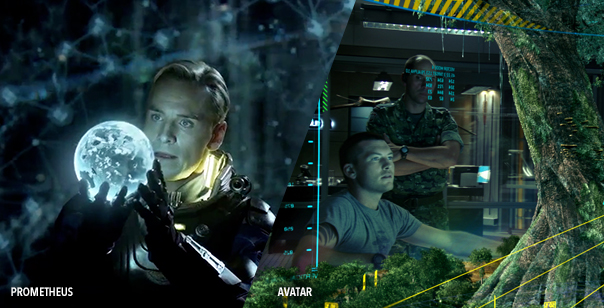
The experience with such interfaces doesn't seem seamless anyway; the operation must be more precise, and the interface should be intuitive and usable with as little effort as possible (Leap Motion seems to be on a good path…). But is it even possible to work precisely without physically tangible interaction? Many still criticize the lack of haptics on touch displays. In Minority Report, special gloves are used that could enable tactile feedback. Or will it be possible in the future to project something "tangible" into space?
James T. Kirk has shown how it could be done differently: with voice recognition. At least somewhat market-ready with Siri, but still light-years away from interaction like in Star Trek. On the Starship Enterprise, entire galaxies were saved by voice command, Siri can't even reliably tell me the way to the nearest Chinese restaurant. Moreover, at least one button press is needed for every command to wake the lady from her second-long sleep. Annoying. The "dialogue" with voice computers must become significantly simpler and more natural.
Tony Stark—who, by the way, has no problem having a nice chat with his artificial intelligence JARVIS—has a chic HUD built into the helmet of his Iron Man suit.
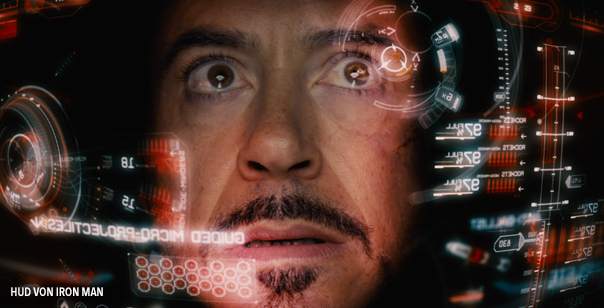
Here he can interact with the interface simply by "looking." But how does the system know whether the user really wants to activate an interface element or is just glancing over it? Unlike, for example, with a mouse, the eye is constantly in motion. The guys at Google are surely already working on solving this problem, because with Project Glass, they are already getting pretty close to this vision.
And that's what it's ultimately about: Film makes visions visible. Hollywood doesn't have to check its interfaces for usability; heroes simply don't make mistakes. There are no technical limitations, all resources can be focused on the styling of the interface. Imagination knows no bounds. This allows filmmakers to think even further, creating visions that might seem absurd today. Desires are awakened in the viewer, motivating researchers and designers to take this inspiration and turn it into reality—albeit a little differently.