Kaleidoscope VR Event in Cologne
, Demodern

We jumped on the VR hype wagon some time ago with a few experiments and applications like Loftshift or VR Swing. Therefore, we didn't want to miss the opportunity to see what other VR artists & producers are doing in this field.
The event featured 32 exhibitors with their own films and interactive applications. At the current time, it becomes relatively clear that the scene is mostly occupied by independent filmmakers and creatives. The quality of the recordings, the cuts, lighting, etc. – it quickly becomes apparent that Virtual Reality is still in its infancy.
It quickly becomes clear: these are 360° VR videos. And without interaction, the whole thing feels – well – somehow wrong. This doesn't change after a few minutes. It becomes boring and increasingly annoying.
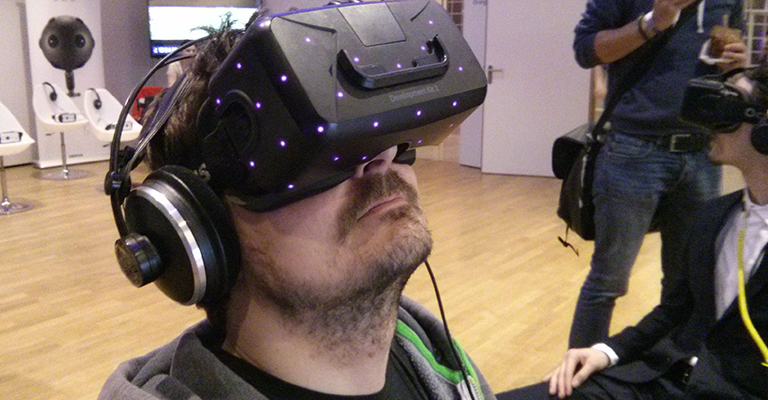
The Oculus Rift with head tracking has a clear advantage over the Gear in that you can not only look around but also enable further perspectives with head movement. While with the Gear, you quickly get the feeling you're looking into a 3D sphere, the immersive feeling is enhanced with the Rift. Unfortunately, all the demos were only exhibited on the DK2 – personally, I would have been interested in the Rift CV1, which brings some innovations compared to the DK2.
The HTC VIVE is, for me, the definitive winner of the event and in the Augmented Reality segment. HTC has succeeded in linking the virtual with the real space and exploring new interactive paths – and clearly stands out from simple 360 videos. Chris Milk said in one of his TED Talks, "Unfortunately, talking about virtual reality is like dancing about architecture." and that's true. If you haven't experienced the difference yourself, it's very difficult to describe the excitement.
The easiest way for me to put it is as follows. While with the Rift and Gear, I had the feeling that I wanted to end the experience, with the HTC VIVE, I had the opposite feeling. I simply didn't want to return to reality. (I like reality ;)) This makes the whole thing somewhat spooky, but that's just how it is.
Unfortunately, we didn't get an HTC VIVE Dev Kit last year – so we haven't been able to actively experiment with it until now. Fortunately, we have had the opportunity to test this fine device a few times. Our ideas are limitless – but what is really interesting and above all useful, time will tell. Currently, some things are purely self-serving.
The use cases of HTC Vive are certainly quite different from those of the Gear and Rift. Especially since the VIVE works stationary and requires physical effort. The Gear and Rift, on the other hand, are more mobile. I could very well imagine the VIVE for vacation planning, house renovation, training, medical applications, etc. But let's see where the journey will take us.
An application that premiered at Kaleidoscope was "LA PÉRI: APRELUDE". When you enter this VIVE app, you initially stand on a theater stage. Alone. But shortly thereafter, a dancer appears, who with her organic and realistic body movements appears absolutely human and realistic. The boundary between VR and reality blurs. You hardly notice the not quite perfect graphics, and the brain suggests to you, "This is real! Dance with her."
Here I quickly realized that not the realistic graphics, but primarily animations and movement sequences are important to make the experience human. At this point, I recall the study from 1944 by Heider & Simmel, which shows exactly that. Namely, that even geometric shapes can take on human traits. (I must admit, with even finer easings, the persuasiveness would have been even more pronounced).
To conclude: We are excited and look forward to building our first VIVE experiments and experiences and observing how this sector develops. There are some topics and areas where VR is currently hyped unjustly, or where the application areas do not even exist yet.