Live, Raw, and Augmented: Social Media as a Starting Point for AR in Our Daily Lives
, Demodern

The Influence
When Kylie Jenner tweeted that she no longer used Snapchat after a new update in February 2018, the stock value of the social media giant plummeted by 7% - equivalent to a market value of about 1.3 billion dollars.

The enormous influence of the Kardashian sister is not too surprising, considering she appeared on the Forbes billionaire list in March 2019 at the age of 21, with her net worth today around 900 million dollars. Jenner's success is even more impressive when compared to established brands. The cosmetics brand Bobbi Brown took 25 years and the L'Oréal brand Lancôme 80 years to break the 1 billion dollar mark. Kylie Cosmetics (@kyliecosmetics) was launched just 5 years ago.
But how did Kylie manage to build such a thriving business in such a short time? Surely, her Kardashian family background is not insignificant, but the brand became an e-tail phenomenon primarily thanks to clever social media marketing. Jenner and her crew have built a massive following on their social media channels (she now counts over 184 million IG fans). In her stories, she announces product launches, posts unboxing videos, and shares which shades she wears daily.
According to a study by Esteban Ortiz-Ospina, young adults engage very frequently with social media (the average in OECD countries is almost 90%). Millennials and the younger Generation Z spend a relatively large part of their time on social networks to identify with their idols and feel like they are actually participating in their lives. Given this, one can hardly ignore the connection between Kylie's presence there and her business success. Traditional marketing tools like classic advertising or PR are becoming increasingly unpopular, especially in terms of their credibility.
Social media determines trends that go beyond the horizon of contemporary advertising and visual arts.
One of the latest success stories of new social media trends is certainly the face filter. They are everywhere. When I say "filter," I am referring to the interactive augmented reality (AR) snaps that can be used via the Instagram camera. They are shared in the platform's "Popular Stories" feature - with 500 million daily users and growing. With just one click within a story, the filters are incredibly easy to access.
The Birth of socialAR
This symbiosis of social media and augmented reality is - beware, buzzword - called "socialAR." Early popular examples are Snapchat's classic puking rainbow and the dog ears and nose. Beautiful and fun filters have been conquering the internet for years. One reason for the recent market boom is the software used to create these effects - it is accessible to the general public. And it's free. Lens Studio (Snapchat) and SparkAR (Facebook and Instagram) allow innovators to create and publish interactive AR effects without needing a background in coding or 3D design.
As you might imagine, artistic expressions are becoming more unique and abstract as the whole world is now suddenly able to program filters. Their creators play with different materials and their physical properties to create filters that look and behave beyond the real world. One such creator who blurs the lines between physical and digital is Johanna Jaskowska, @johwska. After launching the face filter Beauty3000, she became virtually famous overnight, and her follower count rose to 15K - today she counts more than 700K.
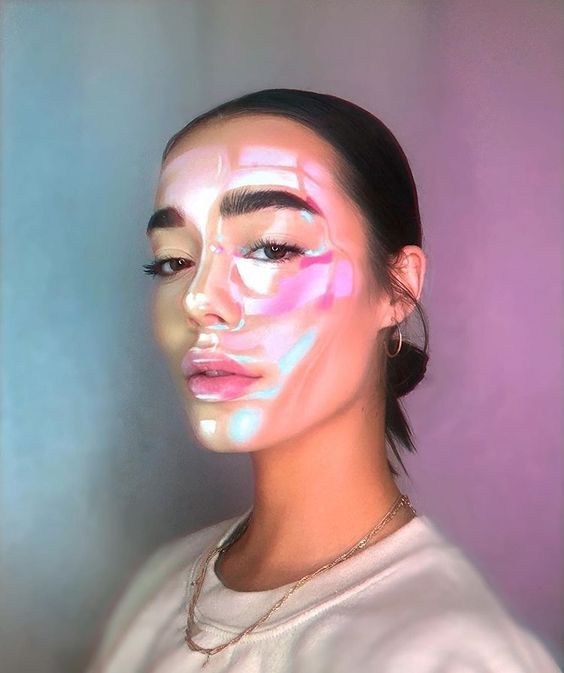
Agnes Matilda (@byagnesmatilda) "wears" Beauty 3000 by @johwska.
The filter makes her look like a human cyborg, covering the face with a mirror-like shiny plastic layer. Highlights appear in shimmering turquoise, hot pink, and paper white. Since the release of Beauty 3000, Johanna has landed a job as a creative at NIKE's headquarters, and in her spare time, she continues to create face filters for names like Billie Eilish or J. Balvin.
AR Shifts Boundaries
With the integration of ever-new hardware and software, AR is becoming much more integrated into our daily lives. Almost everyone with an Instagram account and a modern smartphone has tried an effect at least once. The possibilities go far beyond the "simple" face filter:
Facetracking is used to create effects that react to or mimic a person's face. Combined with a facenet, it creates a surface that can recognize facial movements and expressions. Adding materials creates mask effects like Beauty3000. Objects can be precisely positioned at specific points on the face, such as the chin or eyes. Thanks to the success of Pokémon Go and continuous performance improvements on mobile devices, immersive gaming is becoming increasingly popular. Game filters go viral because they are addictive and fun. In my team, we recently developed a series of SocialAR games controlled by head or face movements. Filter games are fun and hard to stop. Ultimately, users are likely to share these experiences with their friends and fans.
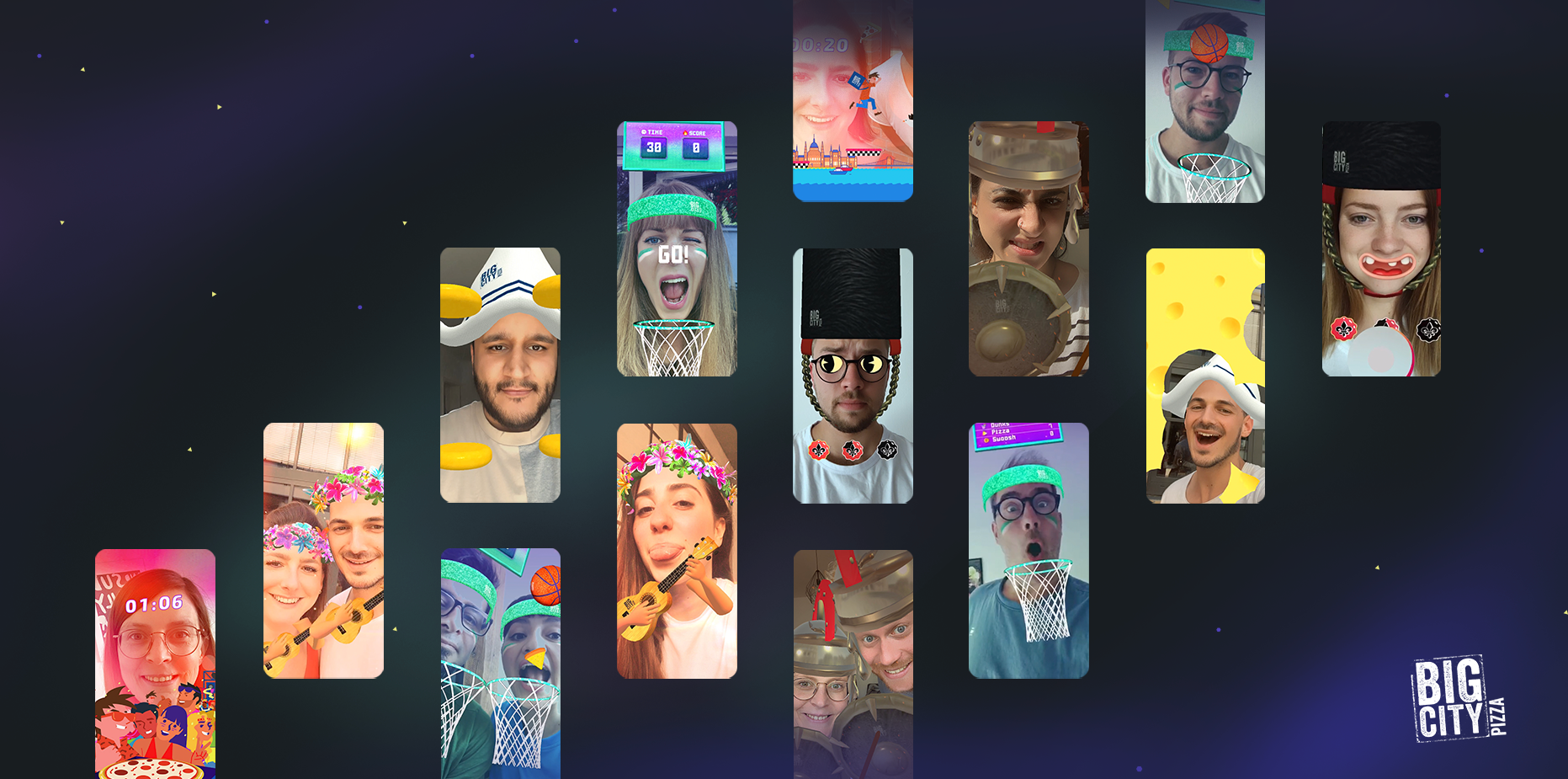
AR games and face filters by Demodern
But just because the face is the most popular stage for AR doesn't mean there aren't other possibilities - and places - to use such a dynamic and flexible tool. 3D objects can be enlarged and placed anywhere in our real world. The objects seem real because they appear anchored to a surface and can play various animations. This offers a great way to showcase products from all angles and try out colors and variations. Effects triggered when the camera is pointed at an image in the real world use an image tracker. The most promising scenarios where this technology is used are interactive posters and billboards or AR packaging extensions, which you can access from your own device.
These are just a few of the many AR use cases, and augmented reality is evolving into a powerful marketing tool across a variety of industries. By 2023, 2.4 billion AR users are expected - that's more than 30% of the world's population.
eCommerce 2.0
Immersive formats are also gaining traction in the world of e-commerce. With the ability to virtually try on a pair of shoes or a new pair of sunglasses before buying - all from the comfort of your home - AR can be used to break down barriers for potential customers and boost brand sales.
Kylie Cosmetics is among the brands that have used AR to enhance e-commerce with an Instagram filter that allows customers to try on seven different lipstick shades from their lip kits. The filter is a perfect solution for many of her customers since the products can only be ordered online or purchased in pop-up shops in the USA. With the filter, customers can test which lipstick color suits them best, regardless of where they order - no pop-up shop necessary.
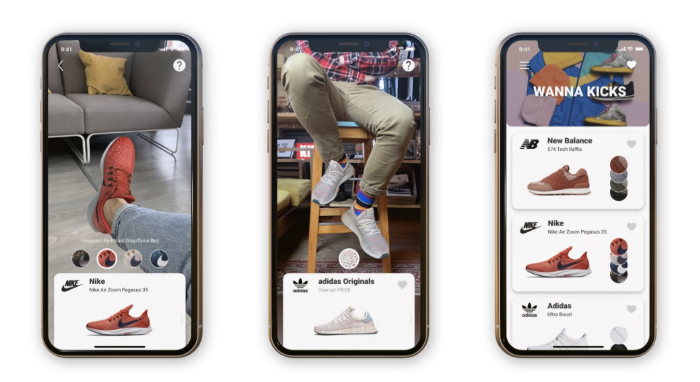
AR shopping lets you virtually try on a pair of shoes. Image from techcrunch.
"The magic of AR creates a radically different kind of shopping experience that goes beyond what digital or physical products alone can offer."
- Ross Neumann, Lowe's InnovationLabs
OK, We Are Evolving Quickly. What's Next?
Good question. We live in a world that is moving more and more online, and COVID-19 is certainly accelerating this transition. People's online personas are gaining value every day. We can create appearances that would hardly be possible in reality - quickly and adaptively with a click. The next step? Digital clothing. Johanna Jaskowska has just sold her first exclusively digital garment. Yes, you read that right. The dress does not exist physically, and she sold it for $9500.
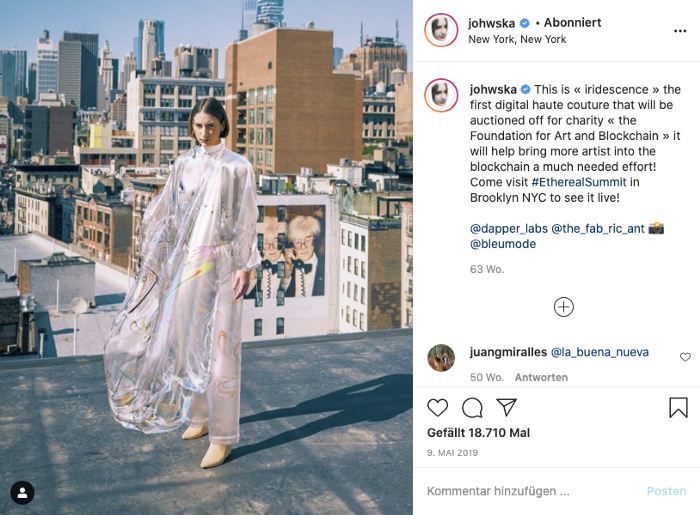
Johanna Jaskowska (@johwska) on Instagram
Digital fashion is nothing new to us. I remember my younger self spending a lot of time dressing up my Sims, and today we even dress our mini-mes in designer clothes (like when Epic and Nike teamed up and designed Fortnite applications for the Air Jordan). With the help of AR, we can overlay not only our avatars but also our own bodies with virtual pieces, giving the social media society new looks without actually having to produce physical garments.
Is this the future? Could be, I would say. It's no secret that our fast fashion usability is causing irreparable damage to our planet. If digital clothing helps counteract that, why not? Personally, I also see great potential in augmented reality initiating a larger societal rethink. It fits a time when younger generations, in particular, are freeing themselves from what society imposes on them: gender stereotypes, beauty ideals, or racial attributions. It is a tool that helps everyone who longs for self-determination. A central question we must, of course, ask ourselves is to what extent our digital identity still represents our physical self - are we distorting reality too much by wearing masks and filters? It's all a matter of perception. One thing is certain, however: augmented reality will continue to change our lives in the long run.
Thank you, your Lea.
The article was originally published on Medium!