Location Marketing: How Innovative Technology Brings Cities and Regions to Life Virtually
, Demodern

Regionality is trending. Therefore, it is hardly surprising that city, location, and regional marketing are booming. Campaigns and actions to promote cultural, historical, or architectural highlights and peculiarities of a city or region are becoming increasingly digital, interactive, and virtual. The advantages and opportunities of attention-grabbing installations and mixed-reality measures for location marketing are described by our Managing Partner Alex in a guest article for new business.
Discovery Dock in Hamburg
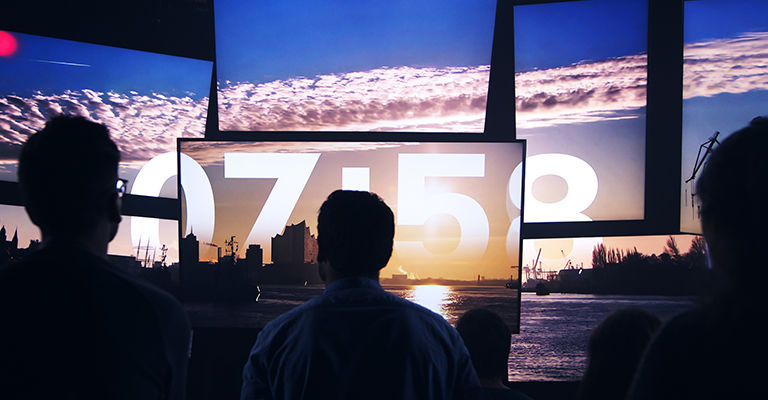
An interactive harbor model shows the real-time data of Hamburg's ship traffic and tides of the last 24 hours in fast motion. With the help of flashlights equipped with motion sensors, exhibition visitors virtually assist the Hamburg customs in searching for smuggled goods. Simultaneously, they experience the hidden underwater world of the Elbe in a realistic 3D reconstruction – including animals that react in real-time to interactions. For example, the crab snaps at the visitor's finger when they touch the glass of the screen. What sounds like science fiction is a prime example of modern location marketing. "Discovery Dock" is the name of the innovative, interactive permanent exhibition in the Port of Hamburg: Various digital installations, including several AR and VR applications, playfully convey the diversity of the Port of Hamburg along an experience path.
Location Marketing: Immersion Instead of Just Experience
Interactive installations, innovative terminals, or mixed-reality measures are considered the means of choice when it comes to making the history of a city or region tangible. At the same time, background information, previously inaccessible content, and facts can be conveyed in an engaging and entertaining way. These types of technologies and applications are increasingly used, especially in the context of events or anniversaries.
For example, the city of Ulm uses a VR application to bring the history and architecture of the Ulm Minster and the city closer to tourists and locals in an innovative way: In a room rented specifically for the 'Ulm-VR-Experience,' visitors explore the building under construction in 1890 from a bird's-eye view. Lying on their stomachs on a surface, the user controls the VR flight simulator with their arms as wings. An integrated fan adjusts the airflow according to flight speed, making the application even more realistic. The VR technology here not only shows what is already possible today but also how effective and relevant it is compared to other media. Such an immersive experience can hardly be achieved through other channels.
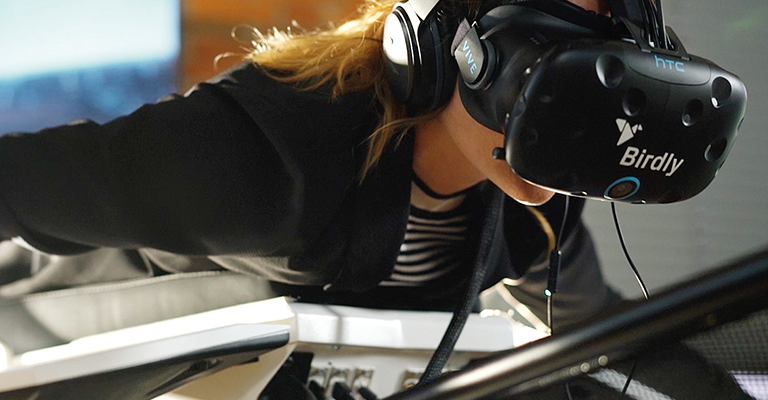
Also, TimeRide Cologne, a VR application at Cologne's Altermarkt, is a successful example of the effective use of innovative technologies in regional communication. In this VR measure, users take a virtual tour through the old town of Cologne during the imperial era in a replica of a historic tram. Or the VR app “Nefertari: Journey to Eternity,” which takes the user into one of the most detailed monuments of Egyptian culture. Thanks to a 3D scan, the tomb of Queen Nefertari is even walkable and simultaneously has a photorealistic visual quality on a 1:1 scale.
Virtual Participation in Construction Projects
Young people today are increasingly informed thanks to social media – including about what is happening and planned in their cities or communities. And they want to have a say, for example, when it comes to important regional construction and renovation projects and urban planning measures. Since virtual or augmented reality can particularly visualize spaces and places and achieve effective and impressive stagings, these types of applications are especially effective in construction projects or architectural interventions, for example, in the streetscape. An interactive installation from Swedish Lapland shows what such a project looks like in practice: An expanding iron ore mine forces part of an arctic small town to completely relocate. A costly project that takes almost two decades. To share the plans for the relocation with the public in advance and gather their feedback, a Swedish consulting firm developed a virtually walkable model of the city. This way, citizens learn how their city will look in the future and can participate in the urban planning discussion.
Technology Meets Storytelling
Whether and to what extent it makes sense to rely on innovative applications and concepts in location, city, or regional marketing primarily depends on the usage scenario and the story to be told. Especially when it comes to creating impactful experiences, immersive adventures, or extraordinary stagings, mixed reality technologies are almost indispensable. They enable users to have an extraordinary experience and immerse themselves in facts and information that were previously conveyed in a rather static and thus less entertaining way. Besides the mere visualization of events, storytelling within such applications is also essential so that the user becomes part of the action playfully or narratively. In line with the gaming sector, this increases the entertainment value and the user's duration in the application. And not only on-site: With the home use of VR hardware, for example, a sight can be virtually viewed before the planned trip, allowing for planning or bookings to be made. Thanks to the rapid development of new technologies, faster and graphically optimized hardware, and mobile 5G data networks, the possibilities for virtual and interactive location and regional marketing are virtually limitless in the future.