Welcome to the VR Funnel

So, has virtual reality already captivated you? Does it deliver on its promises? If not, it was the wrong application or an old device – I'm sure of it. Because anyone who has ever had the chance to dive into virtual reality is fascinated!
If the term "virtual reality" makes you think of nerd stuff that's kind of nice but won't last, let me share my theory: We live in a two-class VR society. In one, the postman brings a new device almost daily, everyone cheers, and meetings are held in virtual rooms. In the other world, the spark hasn't ignited yet. Although the major media houses write about it, the techie reports for a niche audience quickly lead the rest to criticize the anonymization of the world through VR and talk about lonely regulars' tables.
We need to change this mindset. Imagine Demodern as a VR ambassador. We convince brands to create innovative experiences with the help of virtual reality. With various projects, we have already been able to lower initial barriers and encourage a more natural interaction with the technology. Our goal: to fully exploit VR's potential in the future. Because if we create more touchpoints with virtual reality, we close the gap and don't have to question every interaction, feature, and function about whether it overwhelms the user. Sounds logical, right? That's why every visitor to our office must first swing.
I'm going to ask you four questions now. If you can answer all with "Yes," you're deep in the VR funnel and have – believe it or not – an edge over most. Each question answered with "No" doesn't automatically make you less cool, but makes the following post all the more interesting for you:
1. Have you heard of Virtual Reality, Oculus Rift, and HTC Vive?
2. Are you interested in it?
3. Have you already tested a VR headset?
4. Already bored?
Good, then I have your attention, possibly your interest, and ideally your innermost desire to engage with the VR topic – you're in the classic A-I-D-A model (Attention, Interest, Desire, and Action).
Yes, I'm swinging the old advertiser's A-I-D-A club here, but I'm not just squeezing a new technology into old frameworks. I'm writing about the impact model for the following reason: Regardless of whether you answered the questions above with "Yes" or "No," it's important to put yourself in the user's shoes anew when it comes to virtual reality. The model is intended to help in the consideration and preparation of a VR project.
Come with me, I'll lead you into the VR Funnel. It's much more comfortable than it sounds, I promise!
#A … Attention
Ok, attention – granted! The first acquaintances in the Facebook feed post profile pictures with VR headsets. They show which part of society they belong to. It becomes clear: VR alone stands for Awareness, Attraction, Awkwardibility.
Even if we think the topic is on everyone's lips, only a few have experienced a VR experience so far – at least on the other side of the marketing boundary. Unlike web applications, we can hardly rely on learned behavior in the broad masses in the VR area. This can be challenging but creates new opportunities for more intuitive interaction possibilities.
That brings us to #I… Interest
Basic interest in the VR topic is certainly present. But this should not only be based on the new technology, but much more on the possibilities. Lack of imagination in every area of everyday life can thus be circumvented. No one has to imagine an end product based on two-dimensional sketches. This step has already been attempted to be replaced by web configurators, but only the relation to one's own person makes it tangible.
Nevertheless, virtual reality in general and putting on a VR headset in particular can be intimidating. Putting on the headset means a piece of control loss for the user. He can no longer perceive his surroundings, but they can perceive him. Not to mention the loss of style factor, which is roughly equivalent to wearing a bicycle helmet.
These are, of course, not rational reasons to refuse a technology, just reservations. Currently, about 10 million VR headsets are in circulation worldwide. Only a few have access and can even ask themselves if they would try it. To transform reservations into an "I'll try it" need, it's important to create presence and contact points.
And this is exactly where the opportunity for brands lies. Brands have the means and the content to transform their ideas into a VR experience. Apart from that, they emphasize their trendy and innovative character through the combination of marketing and technology. If a brand enables access, it opens up a new platform for itself. The brand transforms Interest into Desire.
This step was taken by the New York Times. To position itself as a media house at the pulse of time and create access to the new NYT VR app, the company sent Google Cardboards with the Sunday edition in November 2015. More than 1 million users came into contact with the technology.
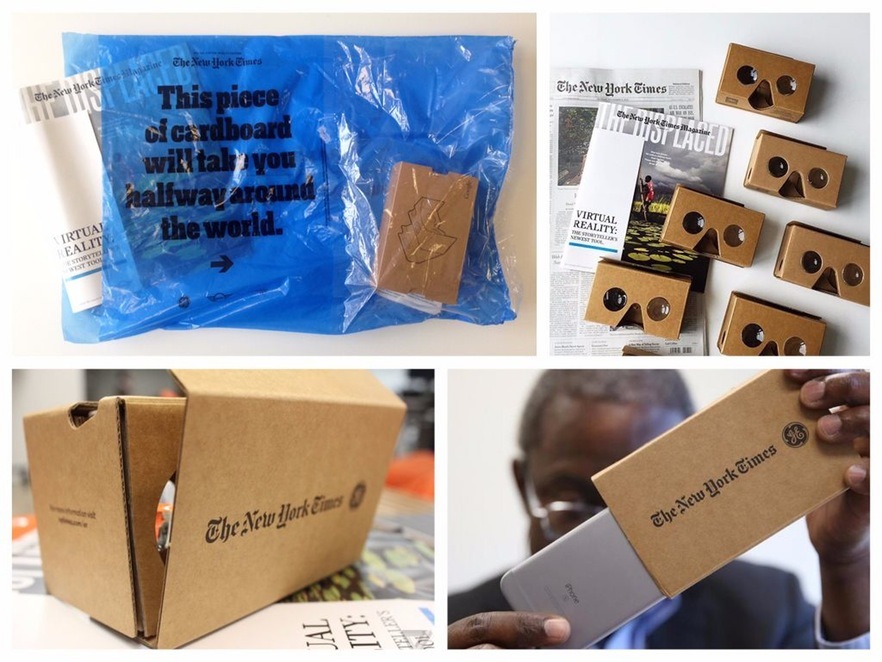
#Desire
So let's imagine a brand as a VR enabler. Trade shows, showrooms, or stores become places of wish fulfillment through installation. This must be taken into account in VR conception. It's less about elaborate interior design planning and more about creating an appealing feel-good atmosphere. Apart from dangerous cable paths and shaky seating, it's mainly about the necessary privacy or the integration of spectators.
In past projects, we allowed the surrounding audience to participate in the VR experience via a display. Here we showed the user's perspective, activated, and created a realistic expectation. If I have already been a witness, my own inhibition threshold decreases, and the "try-it-yourself need" increases. In fact, very few really know what virtual reality means or how it differs from augmented reality. The fact that everything is technologically possible today fuels expectations that can quickly explode the craziness scale.
Ready for A… like Action?
Finally, put on the headset and start the application. The initially described fear is replaced by curiosity. After getting used to it, the VR funnel has taken hold. Everyone wants more. The senses are engaged. Sounds trivial, but it's precisely the engagement of the senses that distinguishes the VR experience from previous ones. The adjustment to the closed field of view of the headset, which still allows a 360° panoramic view including sound, overwhelms the user.
The quality of the display achieved with Oculus Rift and HTC Vive is breathtaking. Regardless of whether the recreated scenery resembles a real space or a fantasy world: For the user, it feels like they are really there! Tracking and visually generated reality through light, shadow, and perspective make them a part of the space.
This tricking of the brain is impressive. For everyone.
What follows from a UX perspective must be considered more specifically in a new post. The A-I-D-A model is exhausted for today, and so is every first-time user.
To be continued ...