Directing, not prompting: making AI creative work controllable again
, Alexander El-Meligi
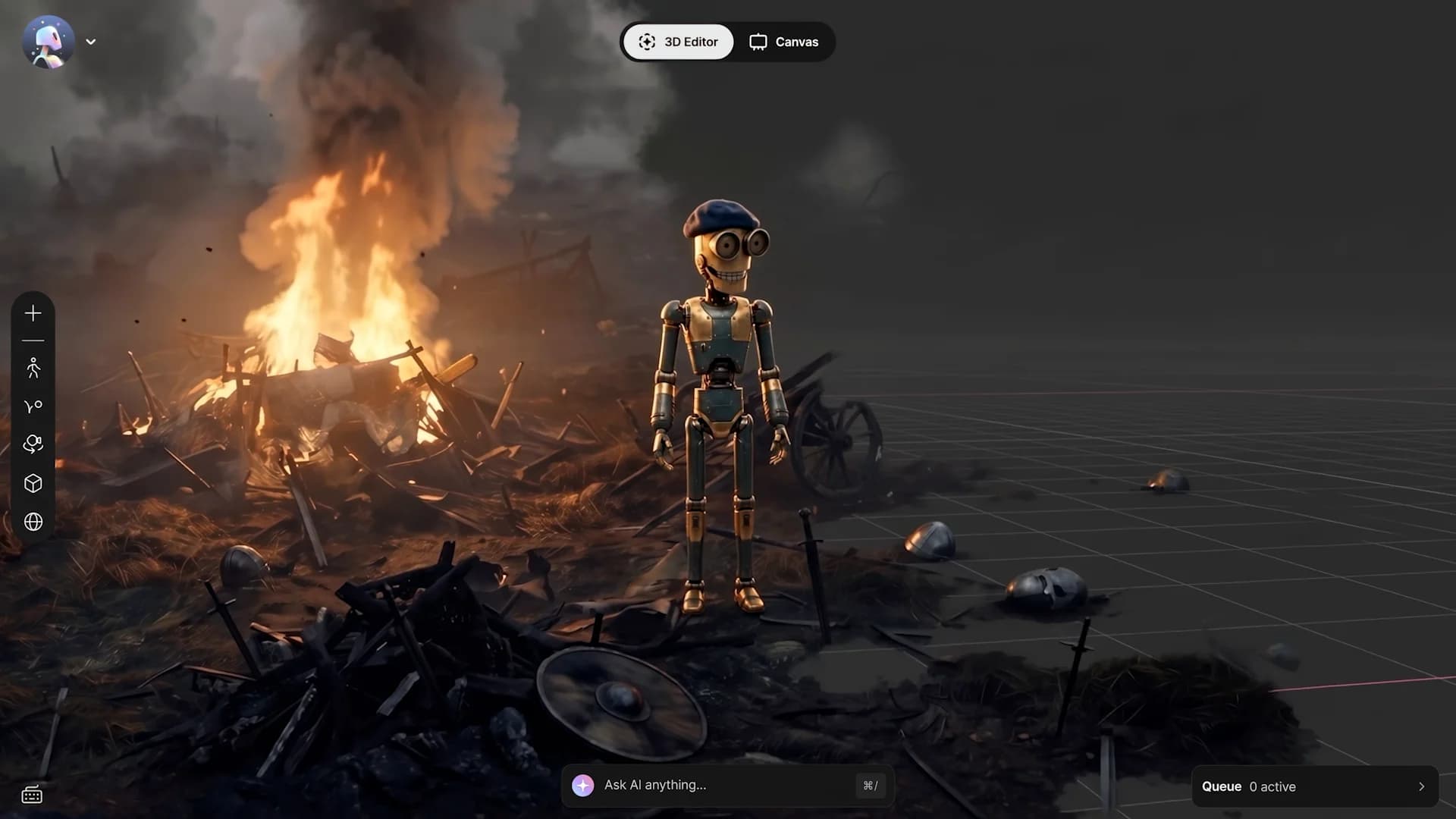
Generative AI first reduced creative work to the prompt: you describe what you want and hope for a fitting result. Now tools from Unreal to Autodesk to World Labs are building control back in, letting creatives stage scenes in 3D again while the AI delivers the look. For brands, that means quality comes from direction again, not from luck with a prompt.
The problem with the prompt
A prompt is a description, not an instruction. You phrase it, you wait, and you get a result that sometimes fits and sometimes doesn't. For exploration, that's great. For work where framing, product and brand have to be right, it's a gamble.
At an evening on agentic AI in Berlin, one thought stuck with me: AI can do an enormous amount by now, but it has no gut feeling and no taste. It needs direction. The question is where that direction happens.
Three signals from one summer
At State of Unreal in June 2026, Epic showed a real-time Unreal scene rendered in high quality by a diffusion model, conditioned on the actual scene's depth, surfaces and camera. So the model respects the framing instead of guessing it from a prompt. Then an element can be masked out of the generated image, turned into a 3D asset and placed back into the scene.
In August, Autodesk followed with 3D Editor and Canvas in Flow Studio. The idea: you stage in real 3D, the way we think spatially, and the AI takes care of the final look. Autodesk puts it this way: "We live in 3D, and we direct in 3D."
And in early September, World Labs released Atlas, a world model that creates entire spaces from text, images, video and 3D, with output including Gaussian splats. World Labs itself describes the difference as staging a scene rather than pulling the lever of a slot machine.
Direction, not a gamble
What all three have in common: the boundary between authoring in 3D and generating with AI is dissolving. You direct, the model expands, and everything stays editable.
For brands, that's decisive. A product has to be right, proportions and materials have to be right, a campaign has to stay consistent across many visuals. You can't roll the dice for that. You can only direct it.
Still early
Much of this is early. Atlas is in early access, the tools are scattered, and the workflows between them are still manual. Prompts remain useful, especially for exploration.
But the direction is remarkably consistent. The industry is building back the control the prompt took away at first.
Who directs
In the end, the role of creatives isn't moving away from craft but back towards it: camera, space, light and composition become decisions again, not wishes. Directing beats prompting.
See how we integrate AI into creative production and brand experiences in Artificial Intelligence.