Technology belongs in the recipe, not on top
, Alexander El-Meligi
Technology doesn't make a brand experience stronger when it's added at the end of a concept. It works when space, content and technology grow from the same question from the start: what should people feel, understand and take away? For trade fairs, events and showrooms, that means digital elements belong in the recipe, not on top.
The sentence we hear a lot
There's a sentence we hear surprisingly often, usually when a client brings us into a project that's already 80 percent planned: "Could we make this a bit more digital? Maybe add some AI?"
I understand where it comes from. Often it isn't really a question about technology. It's a feeling that the concept isn't quite landing yet, and the hope that digital can make up for it. A screen here, an AI feature there, and suddenly the experience feels modern. But technology shouldn't be a rescue plan.
A journey, not a feature set
People don't remember individual touchpoints. They remember the journey as a whole: how they enter a space, what they see first, where they stop and what they take away at the end. A screen added at the end has no place in that journey. It can decorate an experience, but it can't carry one.
The same goes for AI. An assistant on a booth that has no role in the story answers questions nobody asked. The same assistant, designed in from the start, can open the conversation that the people on the booth then take further.
The other way around
The strongest projects don't start with which technology can still be added. They start with what people should feel, understand and take away. From there, space, content and technology become one answer instead of three separate layers.
An example: Discovery Dock in Hamburg
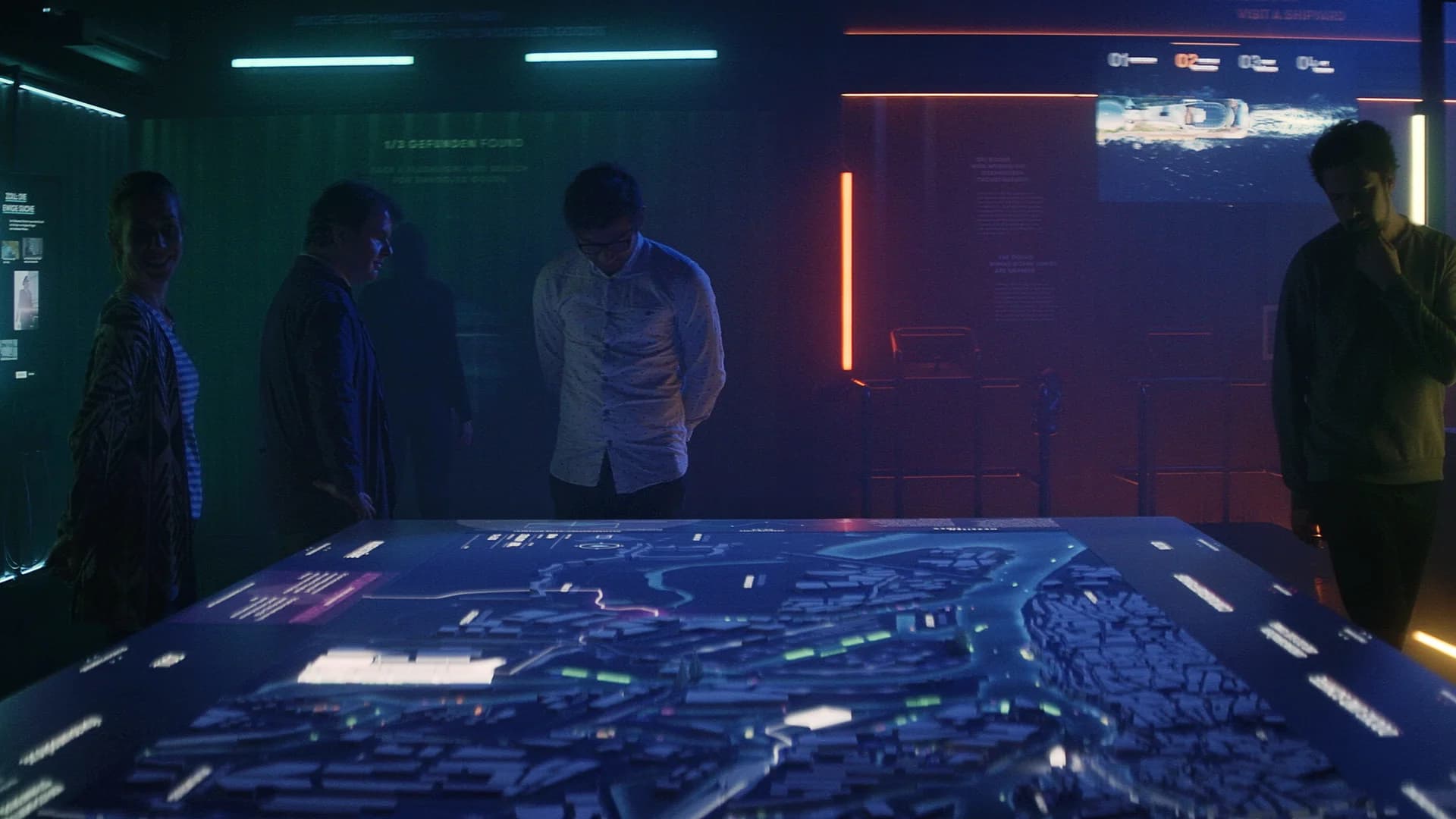
One project I still like to use as an example is Discovery Dock, an interactive experience world about the Port of Hamburg in HafenCity that opened in 2019, with us as lead agency. It didn't start with a list of technologies. It started with a storyline, which served as the creative framework every single station was measured against. Even the name, brand and corporate design grew out of it.
Only then did technology come in, exactly where it could carry the story: a projection mapping on a large harbor model with real-time data as the opener, a transition room with a film installation on eight screens, virtual reality, interactive stations and a 3D audio dome. The space itself was designed as a container landscape of the future. A lot of technology, but no element that was there just because it was possible. More on the project
What justifies the investment
In the end, it's not the number of screens or AI features that justifies the investment. It's a concept where every element, analogue or digital, supports the story and elevates the moment.
That's why three questions are worth asking early in a project: What role does technology play in the story we want to tell? What does the experience lose if we leave it out? And does it enter the concept early enough to shape it rather than just add to it? If the second question has no clear answer, the element is probably decoration.
When technology disappears
The best compliment for a project is never "great technology". It's the moment the technology disappears into the experience, when nobody can tell anymore where the physical ends and the digital begins.
Digital doesn't belong on top. It belongs in the recipe. That's when experiences stop being booths and start being moments. See how we approach this in Trade Fair & Event.