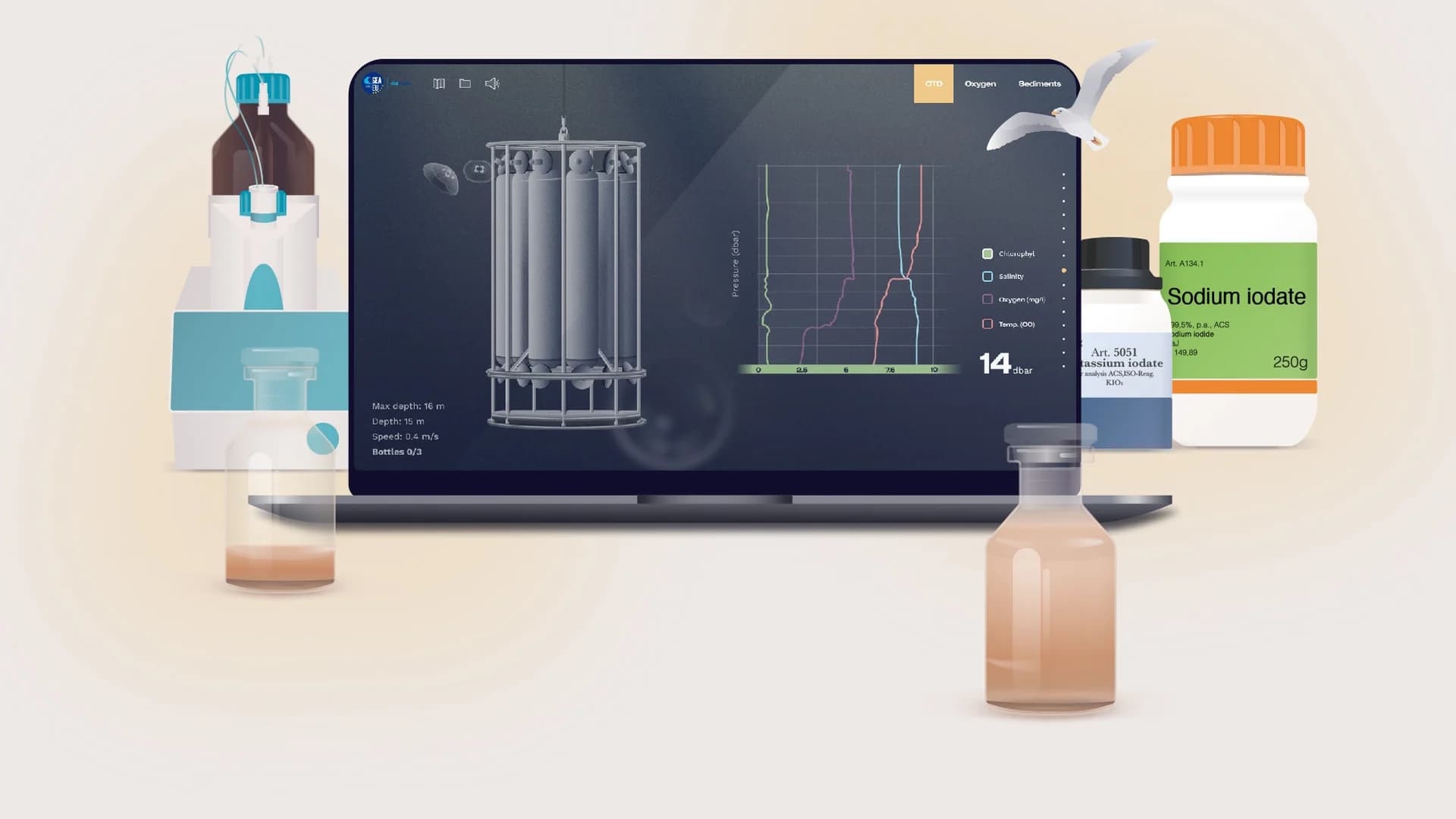
A digital research voyage brings students on board the F.S. Alkor.
The excursion was canceled due to the pandemic.
The real field trip had to be canceled; nevertheless, international master's students should still earn practical credits and experience research content. The goal was to prepare the effects of climate change in the Kiel Fjord didactically, make learning outcomes measurable, and make the content accessible to a wide audience.
The research focuses on three measuring stations in the Kiel Fjord, where oxygen content, water, and sediment samples are taken and analyzed. The real datasets from the last voyage form the scientific basis for the digital exercises.
The research investigates the effects of climate change in the Kiel Fjord.
An interactive eLearning cruise conveys measurement practice and data analysis.
Virtual sampling and laboratory analysis.
The experience consists of three measuring stations, interactive sampling, a virtual laboratory for evaluating measurement results, and contextual testing modules with drag & drop, multiple choice, and sliders. The illustration style combines textbook clarity with modern design.
Based on the real measurement data from the last voyage, students can take samples at three stations and evaluate them in the laboratory. Three measuring stations and a central laboratory module form the core deliverables; qualitatively, the offering enhances the accessibility of research and actively engages students in the experiment.
The presentation is reduced and scientifically accurate, ensuring that complex processes remain easily understandable. Desktop-first was the design focus, complemented by an accessible version that makes learning content available on all devices and for all users.
The experience is textbook-like, modern, and accessible.
Modular design and a custom scroll framework create a connection to practice.
The project proceeded in four clear phases.
The work was divided into Discover, Prototype, Build, and Launch: gathering research context, testing interactive prototypes, building the scroll experience and laboratory modules, and going live with the experience. Each phase was guided by user feedback and didactic evaluation.
The custom scroll framework sets the ship in motion and simulates sampling and measurements, allowing students to look beneath the water's surface and into data relationships. Context-sensitive question modules provide immediate feedback; two charming Baltic Sea residents explain correct solutions with a wink.
The desktop-first strategy provides sophisticated analysis tools, while the accessible version ensures equal access. Technically, the experience is based on real datasets and a performant, easily maintainable architecture, allowing educators to easily maintain and reuse content.
The most impact came from immediate, practical exercises and the combination of real data and narrative context. This increased motivation and allowed students to understand complex relationships on their own.
Key learning: Practical relevance matters.
The digital cruise connects teaching, research, and outreach in new ways.