Spatial web: how AI and 3D are changing the role of the website
, Alexander El-Meligi
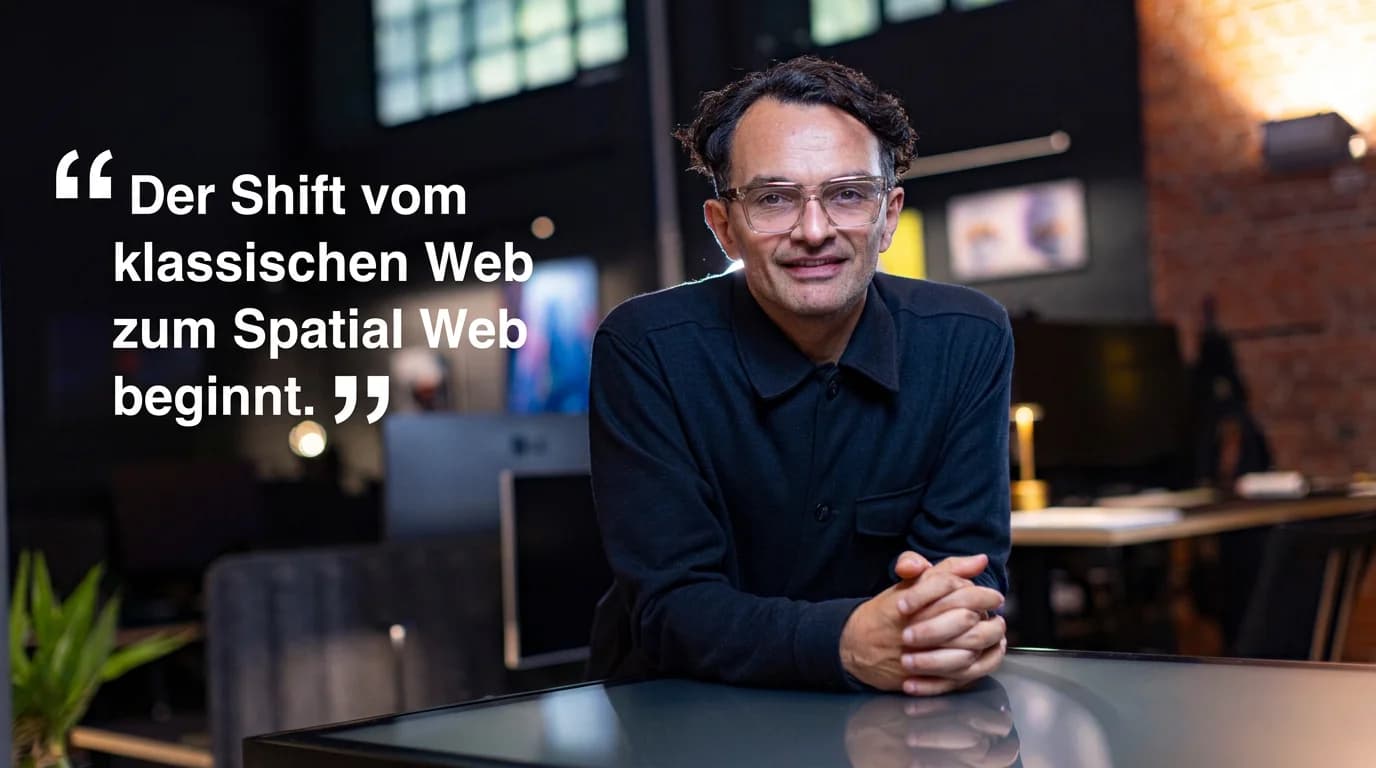
The spatial web is a web where content no longer lives only on pages but is connected to places, products and situations. Two developments are pushing it forward at the same time: AI agents are taking over more and more answers, and the web is becoming spatial through new technology. For brands, this changes the role of the website: explain less of what an agent can summarize anyway, and enable more of what can't be summarized.
The agent is reading along
For a few weeks now, two developments have been coming together for me that are usually discussed separately. The first: AI is leaving the chat window and becoming an agent that searches, compares and summarizes for us. How big this has become is shown by a number from Google itself. According to Alphabet, more than one billion people a month now use AI Mode in Search.
So what a website explains is increasingly read by an agent. A study by Pew Research based on real browsing data from 900 US adults shows: when Google displays an AI summary, users click a traditional search result in only 8 percent of visits, compared with 15 percent without one. Links cited inside the summary itself are clicked in only around one percent of visits.
The Pew data comes from the US, but the pattern has reached Germany too. In a six-country comparison by SparkToro based on Similarweb data, Germany has the lowest rate, yet 62 percent of all Google searches there still end without a click. Not every one of those is a lost visit, some end in a new search or in Maps. And Google points out that AI features in Search send billions of clicks to websites every week. That doesn't contradict the finding, it sharpens it: the website isn't disappearing as a source of information, but it's losing its role as the first point of contact.
The web is becoming spatial
The second development is technical. As I recently described using the example of WebGPU, rich 3D now runs in all major browsers, with one build and one URL, from phone to headset. What used to require an app now opens with a link.
That brings the spatial web closer. The term is used in different ways. What I mean by it is a web whose content you don't just read but step into: a product you can rotate and open in the browser, a piece of furniture standing in your own living room via AR, information that will eventually appear in the field of view of your glasses, right where it's needed. The page becomes a space.
With the next generation of AR glasses, this development gains another dimension, because digital experiences are no longer necessarily confined to a screen. It isn't there yet. Many glasses are announced or available for pre-order, and the ones winning in everyday life are those that do a few things well. The direction is clear, though.
The new role of the website
When agents anticipate more and more information, a brand needs a new reason for people to enter its digital world themselves at all. That's exactly where the role of the website changes. It needs to explain less of what an agent can summarize anyway and enable more of what can't be summarized: experiencing a product, trying out a configuration, exploring an environment or interacting with a brand.
Experience doesn't replace information. An agent still needs clean, structured content to recommend a brand in the first place. But experiences are becoming an increasingly important reason for direct contact.
An example: the 3D Product Explorer
With our 3D Product Explorer, we show complex products interactively and photorealistically: rotate, zoom, switch variants, open moving parts live. The same system runs on the website, on tablets in sales conversations, on displays in showrooms and in AR on phones or headsets. That's exactly what no agent can summarize: how a product feels when you explore it yourself.
What brands can do now
This shift creates three tasks that complement each other. The first is to be readable for agents. An agent only recommends what it can understand correctly. Clear product facts, structured data and unambiguous statements are worth more here than any marketing copy. If a brand shows up wrong or not at all in the agent's answer, it doesn't get recommended, however good its own site looks.
The second is to answer yourself. If people are asking an AI their questions anyway, the brand can offer that AI itself: an assistant on its own website that answers from approved company content rather than general web knowledge. Our AI Chat Agent works this way and also shows which questions are asked most often and where content is missing. That knowledge is lost when the answer happens in someone else's AI.
The third is to invest in experience where it counts. Not every page needs to become spatial. It's about the moments where seeing and trying decide: a configuration, the size of a product in a room, a mechanism you need to understand before you trust it. That's where 3D pays off, elsewhere a well-made page is enough.
Decoupling information and experience
For brands, that means an interesting shift: information and experience are starting to decouple. The agent increasingly delivers the answer, while the brand's digital world has to offer something the answer alone can't. I've described the same idea for commerce: brands now need two experiences, one for the agent and one for the person.
It also changes how success is measured. When fewer people click, traffic alone no longer works as the metric for a brand's digital world. What becomes more meaningful is what people do inside the experience: how long they engage with a product, which variants they try and whether that leads to an inquiry or a conversation. And honestly, the basics stay mandatory even when the experience takes center stage: fast loading, accessibility and a page that reads well without 3D.
That's exactly where both developments meet: AI and the web are leaving their familiar interfaces and increasingly becoming part of the same spatial experience. See how we develop 3D and commerce experiences for web, app and space in Digital Commerce.